

How to increase car wash profits: proven steps for owners and managers
Running a car wash feels simple until you measure profitability. If you want to know how to increase car wash profits, this guide gives practical, tested tactics you can apply this week. First, we explain why profits stall. Then, we show step-by-step actions—pricing, operations, marketing, and technology—so you capture more revenue from every customer and run the business more efficiently.
Why profits lag at many car washes
Many car washes leave money on the table for the same five reasons:
- Poor pricing that doesn’t reflect value or costs.
- Low average ticket because upsells and add-ons are rare.
- Inefficient labor and long turnaround times.
- Inventory losses and unmanaged chemical or parts usage.
- Poor marketing and low customer retention.
How to increase car wash profits: a 7-step framework
Use the following framework as a checklist. Each step contains clear actions, metrics to track, and quick wins you can implement this month.
1. Price for profit and segment your offers
Pricing matters more than you think. First, calculate your true per-wash cost (labor, water, chemicals, electricity, disposables, rent allocation). Then set prices that cover costs plus a target margin.
- Action: Create three service tiers—Basic, Standard, Premium—with clear benefits.
- Metric: Track average revenue per customer and margin per tier.
- Quick win: Raise the Basic price by 5–10% if costs increased in the last 6 months; test elasticity for two weeks.
2. Increase average ticket with strategic upsells
Upsells are the fastest route to higher revenue. Offer add-ons that cost little but command higher perceived value.
- Examples: Interior vacuum + upholstery wipe, wax sealant, wheel shine, quick detailing packs.
- Action: Train staff to ask two simple questions at payment: “Would you like a wax sealant today for KES X?” and “Add a quick interior clean for KES Y?”
- Metric: Track attach rate (percentage of customers who buy an add-on).
- Quick win: Offer a “Today only” discounted add-on to drive immediate purchases.
3. Improve throughput and reduce labor waste
Faster, consistent service increases capacity without hiring. Standardize steps, reduce non-value tasks, and schedule staff by demand.
- Action: Time each operation phase for a week to find bottlenecks.
- Metric: Cars per hour, average service time, labor cost per car.
- Quick win: Reorganize tools and chemicals to reduce movement and shave minutes off each job.
4. Control inventory and cut leakages
Inventory loss—chemicals, towels, spare parts—eats profit silently. Track usage and create reorder thresholds.
- Action: Count stock weekly and log usage per shift.
- Metric: Inventory turnover, variance between expected and actual usage.
- Quick win: Switch to measured dispensing systems for soaps and waxes to reduce overuse.
5. Use data and reporting to make decisions
Good decisions require simple, timely data. Track sales by service, add-on attach rates, peak hours, and labour utilization.
- Action: Produce a weekly dashboard showing revenue by service, busiest hours, and top upsells.
- Metric: Revenue per labor hour, customer retention rate, conversion from walk-in to paid service.
- Quick win: Identify a slow weekday and run a targeted discount to fill those hours.
6. Market to repeat customers and build loyalty
Acquiring a new customer costs 3–5x more than retaining one. Use simple loyalty and membership plans to lock revenue.
- Action: Offer a monthly membership with discounted washes and priority queuing.
- Metric: Percentage of revenue from members, churn rate, lifetime value (LTV).
- Quick win: Create a referral offer: both referrer and referee get a discounted wash.
7. Automate where it reduces cost or improves experience
Automation reduces manual errors, speeds checkouts, and gives management control across locations.
- Action: Implement digital job cards, mobile payments, and automated notifications for bookings.
- Metric: Payment time, no-show rate for bookings, checkout time per vehicle.
- Quick win: Offer online booking with a small prepay to reduce cancellations.
Common mistakes that reduce profit
- Ignoring variable costs when setting prices.
- Relying solely on walk-ins—no scheduled customers or memberships.
- Overstaffing during slow hours and understaffing at peaks.
- Not tracking add-on attach rates or inventory variances.
- Failing to measure marketing ROI and repeating ineffective campaigns.
Costs and ROI: realistic examples
Below are simplified examples to show how a few adjustments raise profit.
| Scenario | Monthly Revenue | Monthly Costs | Net Profit |
|---|---|---|---|
| Baseline (5 cars/hr, KES 700 avg ticket) | KES 672,000 | KES 560,000 | KES 112,000 |
| After pricing + upsells (+15% avg ticket) | KES 772,800 | KES 560,000 | KES 212,800 |
As a result, a 15% increase in average ticket nearly doubles net profit in this example. Small changes compound quickly when applied consistently.
How Garisoul helps increase car wash profits
Problem: Many car washes lose margin from unmanaged inventory, missed upsells, manual bookkeeping, and unclear staff schedules.
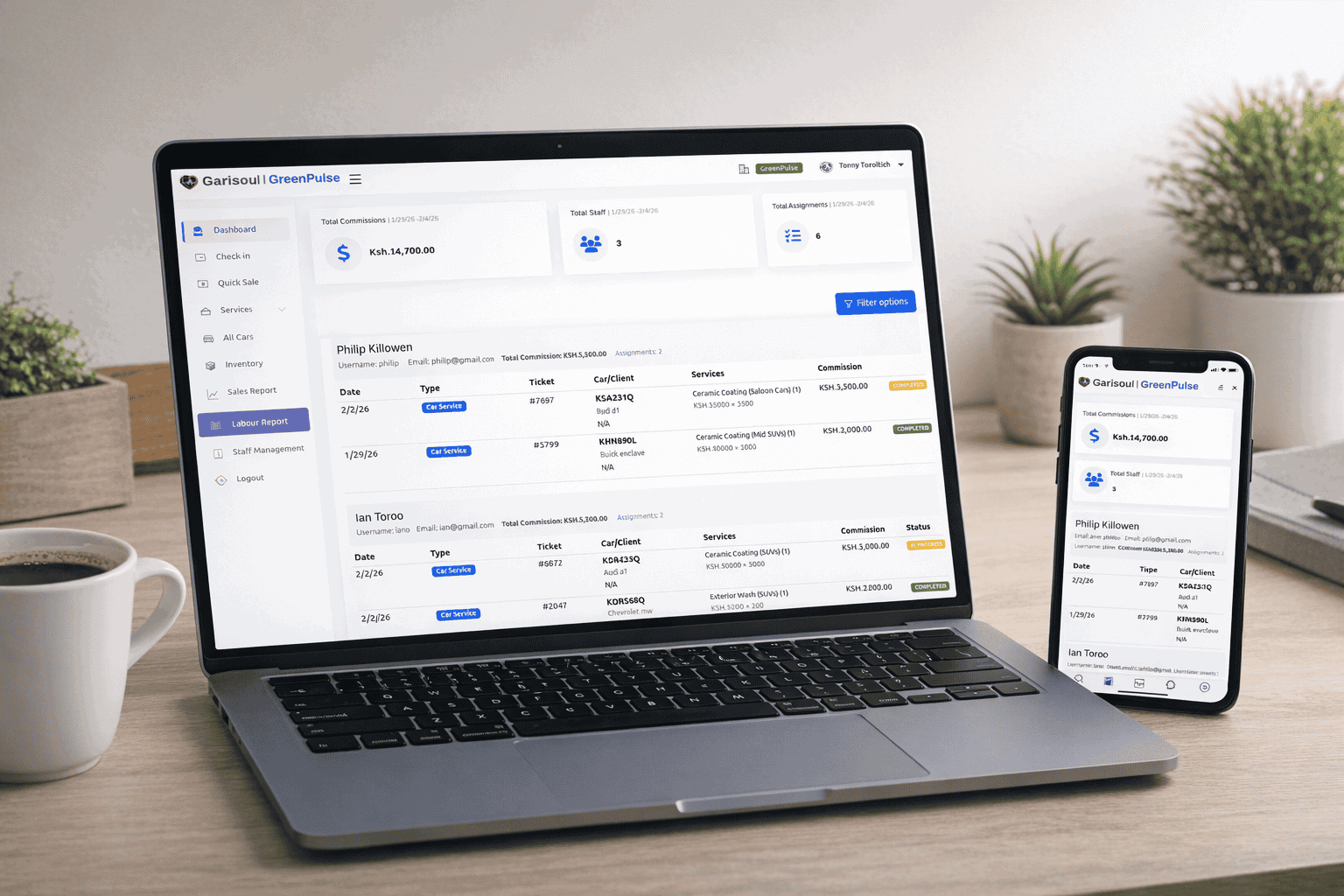
Solution: Garisoul provides car wash management software that centralizes bookings, digital job cards, inventory tracking, sales reports, and staff management.
Business benefit: By automating inventory control and tracking upsells, Garisoul helps reduce waste, increase attach rates, and produce actionable reports. Managers make faster decisions with clear KPIs, raising revenue and lowering operating cost.
Example: What Garisoul automates and why it matters
- Digital job cards: Ensure services and add-ons are recorded, reducing missed revenue.
- Inventory tracking: Prevent overuse and theft by measuring consumption per service.
- Sales & revenue reports: Highlight profitable services and underperforming time slots.
- Staff tracking: Align shifts to demand and reduce idle labor costs.
Customer success story: Eastlands Car Spa (realistic example)
Problem: Eastlands Car Spa in Nairobi struggled with long queues, inconsistent upselling, and frequent stockouts. Revenue plateaued despite growing foot traffic.
Implementation: They deployed Garisoul, trained staff on digital job cards, and set up a three-tier membership. They also used Garisoul reports to change shift patterns and introduced two high-margin add-ons.
Results: Within three months, average ticket rose by 18%, add-on attach rate climbed to 28%, and inventory variance dropped 60%. Revenue increased by 22% and net margins improved accordingly.
Implementation plan: 30-90 day roadmap
- Day 1–7: Audit costs, time each operation, and set baseline KPIs.
- Week 2–4: Adjust pricing tiers, create add-on menu, and start staff upsell training.
- Month 2: Introduce loyalty or membership plan and test targeted weekday promotions.
- Month 3: Implement Garisoul or a similar management system for bookings, inventory, and reporting; refine staff schedules based on data.
Which Garisoul plan fits your car wash?
- Cloud Starter — KES 9,000 / Quarter, KES 7,999 onboarding. Suitable for small car washes and startups that need a low-cost cloud solution to track jobs, run tills, and manage inventory.
- Business Licence — KES 59,999 one-time, KES 12,000 annual managed service, KES 9,999 onboarding. Suitable for workshops, multi-branch operations, and fleet operators requiring advanced reporting and multi-site control.
Choose Cloud Starter if you run a single-location car wash and want fast deployment with essential tools. Choose Business Licence if you manage multiple sites, run larger teams, or need advanced integrations and on-premises control.
Frequently asked questions (FAQ)
How quickly will I see profit improvements?
Small changes—pricing and simple upsells—often show results in 2–4 weeks. Operational fixes and software implementations typically take 6–12 weeks to deliver measurable ROI.
What is the most profitable upsell?
High-margin services with low incremental cost—wax sealants, interior quick cleans, and wheel and tyre treatments—deliver the best ROI. Combine with membership offers for recurring revenue.
How much should I spend on advertising?
Start small: allocate 5–10% of projected revenue to local digital ads and promotions. Measure cost per acquisition (CPA) and optimize campaigns that produce repeat customers.
Can small car washes use Garisoul?
Yes. The Cloud Starter plan is designed for small car washes and offers essential tools to track sales, inventory, and jobs without heavy upfront cost.
What KPIs should I track?
Track average ticket, attach rate for add-ons, cars per hour, labor cost per car, inventory variance, member revenue, and customer retention.
Internal and external resources
Learn more about Garisoul and sign up: Garisoul home.
Get pricing and onboarding details: Garisoul pricing.
Contact Garisoul sales for a demo: Contact Garisoul.
For additional small-business marketing ideas, see this local business resource: SpotOn Vacations business tips. For operational guidance on workflow efficiency, consult this guide: NUR Fertility operations.
Conclusion
If you want to know how to increase car wash profits, focus on pricing, consistent upsells, operational efficiency, inventory control, and repeat customers. In addition, use a management platform like Garisoul to automate tracking, reduce waste, and surface the KPIs that drive decisions. Start with one small change this week—test an add-on or adjust pricing—and measure the result. These compounding improvements will grow revenue and make your business more predictable.