

Car wash software: how to choose, implement, and increase profits
Car wash software can transform daily operations, but many owners buy tools that don’t solve their real problems. First, we identify the common business challenges—cash leakage, slow throughput, poor reporting, and inconsistent customer experience. Next, we give practical steps you can apply immediately. Finally, we explain how Garisoul fits into a profit-first plan, showing measurable outcomes rather than feature lists.
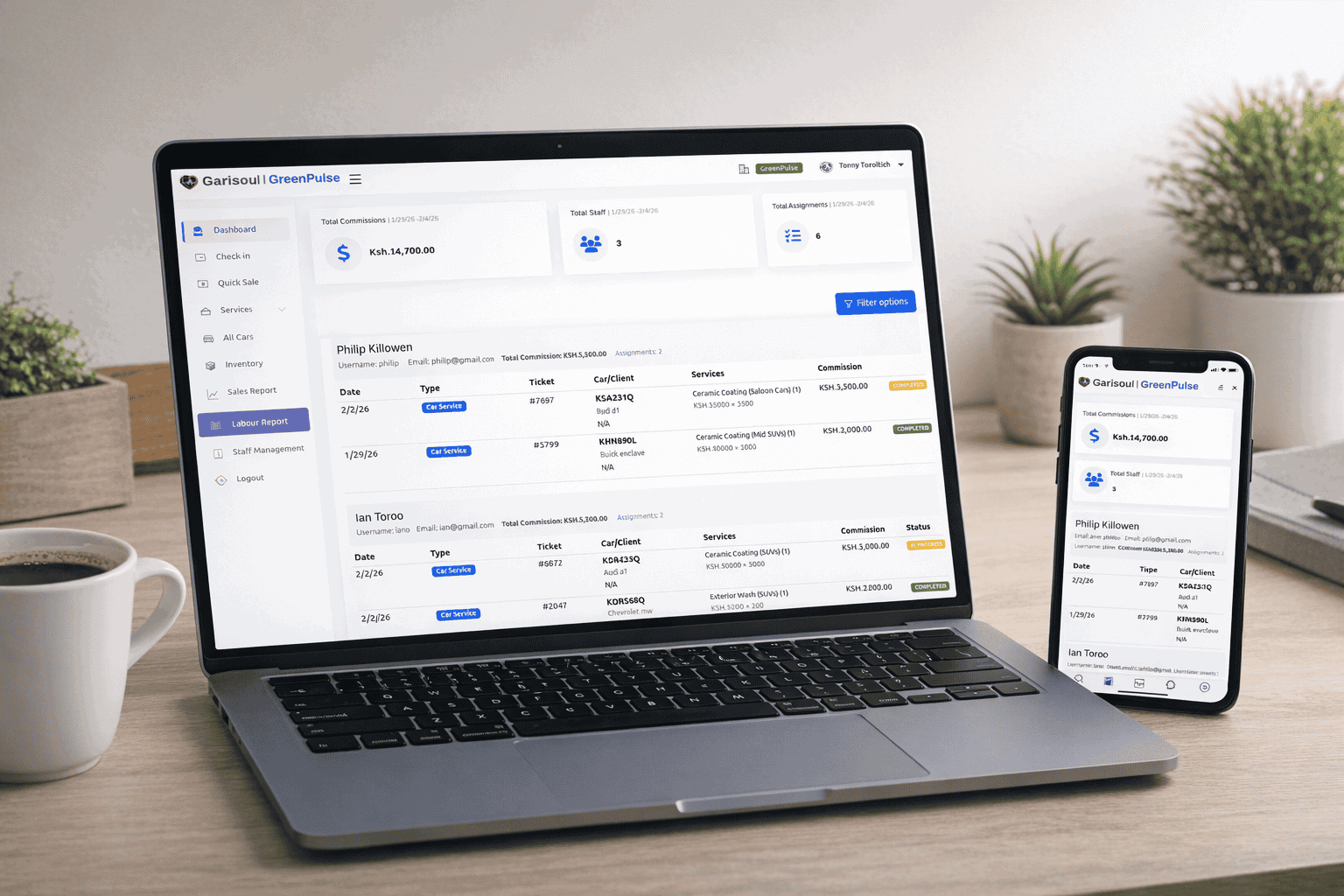
What is car wash software and why it matters
Car wash software centralizes sales, bookings, inventory, staff schedules, and reporting. In addition, it automates routine tasks so managers focus on growth. Without it, owners rely on paper, memory, or spreadsheets that create blind spots and erode margins.
Who needs it?
- Single-site car wash owners who want reliable reporting.
- Growing operations with multiple shifts and add-ons.
- Multi-branch operators who need centralized control.
- Fleet and workshop operators that require service history and invoicing.
Problem-first checklist: common challenges car wash software should solve
Before choosing software, diagnose your biggest pains. Each problem below explains impact and practical fixes you can start today.
Problem: Cash leakage from unmanaged inventory
Why it happens: chemicals, towels, and parts go unrecorded. Managers lack visibility and theft or overuse slips by unnoticed.
Impact: Higher COGS, unpredictable monthly margins, and frequent stockouts.
Fix now: Start weekly stock counts and measured dispensing. Track usage per shift and investigate variances above 5%.
Problem: Missed upsells and low average ticket
Why it happens: staff don’t get prompts and POS is clunky. Therefore, customers leave with basic services only.
Impact: Lower LTV and wasted marketing spend to replace churned customers.
Fix now: Create a short upsell script and test two add-ons for two weeks. Measure attach rate.
Problem: Inefficient throughput and poor scheduling
Why it happens: processes are informal and shifts don’t match demand peaks. Consequently, capacity is wasted or customers wait too long.
Impact: Fewer cars per hour, unhappy customers, and overtime costs.
Fix now: Time each service phase for a week. Then reorganize tasks and align staff schedules to peak hours.
Problem: Lack of reliable reporting
Why it happens: manual records prevent timely decisions. As a result, owners react rather than improve.
Impact: Continued underperforming services and slow growth.
Fix now: Produce a simple weekly dashboard showing average ticket, cars per hour, attach rate, and inventory variance.
What good car wash software must do (and why each item matters)
When comparing products, evaluate capabilities by business outcome rather than buzzwords. Below are essential modules and the measurable benefits they deliver.
- Car wash POS with quick checkout: reduces queue time and increases throughput, so you serve more customers per hour.
- Digital job cards: capture every service and add-on to stop missed revenue and make audits fast.
- Inventory tracking and measured dispensing: reduce chemical waste and theft, lowering cost-of-goods-sold.
- Sales and revenue reports: show which services are profitable, enabling data-driven pricing and bundling.
- Staff tracking and shift analytics: align labor to demand and reduce labor cost per car.
- Memberships and recurring billing: create predictable monthly revenue and raise customer lifetime value.
- Multi-branch management: centralize pricing, procurement, and reporting to scale efficiently.
- Cloud hosting and backups: secure your data and enable remote management.
Buying considerations and checklist
Pick software that solves your highest-cost problem first. Use this checklist during demos.
- Does it record every job and add-on automatically?
- Can it track inventory consumption per service?
- Does reporting include attach rates, cars/hour, and labour cost per car?
- Is the POS fast and mobile-friendly for busy lanes?
- Can you run memberships and recurring payments easily?
- Does it support multi-branch rollouts and central procurement?
- What onboarding and support are included?
- Can it integrate with your accounting or payment provider?
Costs and ROI: realistic scenarios
Software is an investment. Therefore, estimate ROI using conservative assumptions.
| Scenario | Monthly uplift | Typical payback |
|---|---|---|
| Small single-site, attach rate +10%, waste -30% | KES 30,000–60,000 | 2–4 months |
| Multi-branch, ticket +15%, throughput +10% | KES 150,000+ | 1–3 months |
For example, a single-site using Cloud Starter (KES 9,000 / Quarter) that raises average ticket by 12% and cuts chemical waste by 35% will typically recover subscription and onboarding costs within the first quarter.
Implementation best practices
Successful implementation focuses on processes, training, and simple KPIs.
- Map your current workflow and identify one bottleneck to fix first.
- Set baseline KPIs: average ticket, attach rate, cars per hour, inventory variance.
- Train staff on new job cards and a short upsell script. Keep training short and practical.
- Run a two-week pilot on one lane or one branch before full rollout.
- Review weekly dashboards and iterate based on data.
Why Garisoul fits car wash operators
Business problem: Owners lose revenue from missed add-ons, unmanaged inventory, and fragmented reporting.
Why manual methods fail: Paper and spreadsheets create delays and errors. Managers cannot attribute loss to specific causes quickly.
How Garisoul solves it: Garisoul automates job cards, tracks inventory per service, prompts upsells at the point-of-sale, and generates actionable reports in real time.
Business benefit: You see fewer stock variances, faster checkouts, and higher attach rates. Consequently, your margins improve and decision-making speeds up.
Expected business outcome: Reduced cost-of-goods-sold, higher average ticket, predictable revenue from memberships, and faster scaling across branches.
How specific Garisoul features improve outcomes
- Digital job cards: prevent missed charges by recording services and add-ons, improving monthly revenue accuracy.
- Inventory tracking: links stock usage to services, reducing waste and lowering replacement costs.
- Sales reports: identify the most profitable services, enabling smarter promotions and pricing changes.
- Staff analytics: highlight idle time and bottlenecks, reducing labour cost per car.
Customer success story: CleanRide Car Care
Problem: CleanRide ran three lanes with inconsistent upselling and frequent stock discrepancies. As a result, monthly profits stagnated.
Implementation: They onboarded Garisoul Cloud Starter, introduced digital job cards, and trained staff on two add-ons. They set a weekly review of attach rates and inventory variance.
Results: Within ten weeks, add-on attach rate rose from 8% to 30%. Inventory variance dropped 65%. Average ticket increased by 18% and throughput improved by 12%. CleanRide now uses the weekly dashboard to optimize staffing and promotions.
Choosing between Garisoul plans
- Cloud Starter — KES 9,000 / Quarter; KES 7,999 onboarding: Best for single-location car washes, startups, and tyre centres needing fast deployment and core features like POS, job cards, and basic inventory.
- Business Licence — KES 59,999 one-time; KES 12,000 annual managed service; KES 9,999 onboarding: Best for workshops, garages, fleet operators, and multi-branch businesses that require advanced reporting, multi-site control, and managed rollouts.
FAQ
What problem does car wash software solve first?
Software first eliminates blind spots—missed charges and inventory loss. Consequently, owners recover revenue quickly and gain data to improve pricing and staffing.
How long does implementation take?
Single-site pilots typically take 2–4 weeks. Multi-branch rollouts vary but often complete within 6–12 weeks with managed service.
Can small operators afford it?
Yes. Cloud Starter offers an affordable entry point. Most small operators recoup costs within one quarter through higher ticket and lower waste.
Which KPIs should I track initially?
Start with average ticket, add-on attach rate, cars per hour, inventory variance, and labour cost per car. Review them weekly.
Resources and links
Explore Garisoul: Garisoul home.
See plans and pricing: Garisoul pricing.
Request a demo or speak with sales: Garisoul contact.
Additional small-business tips: SpotOn Vacations business tips. Operational workflow references: NUR Fertility operations.
Conclusion and next steps
Car wash software matters because it closes the gaps that cost you money: unrecorded services, inventory waste, slow checkouts, and weak reporting. First, diagnose your biggest pain point and fix one process this week. Next, measure results and run a short pilot with the software that addresses your top issue. Finally, consider Garisoul as the practical solution when you want measurable benefits—higher average ticket, lower COGS, predictable membership revenue, and scalable multi-branch control. To see a tailored plan for your operation, visit Garisoul and request a demo; the right setup usually uncovers quick wins in under 90 days.