
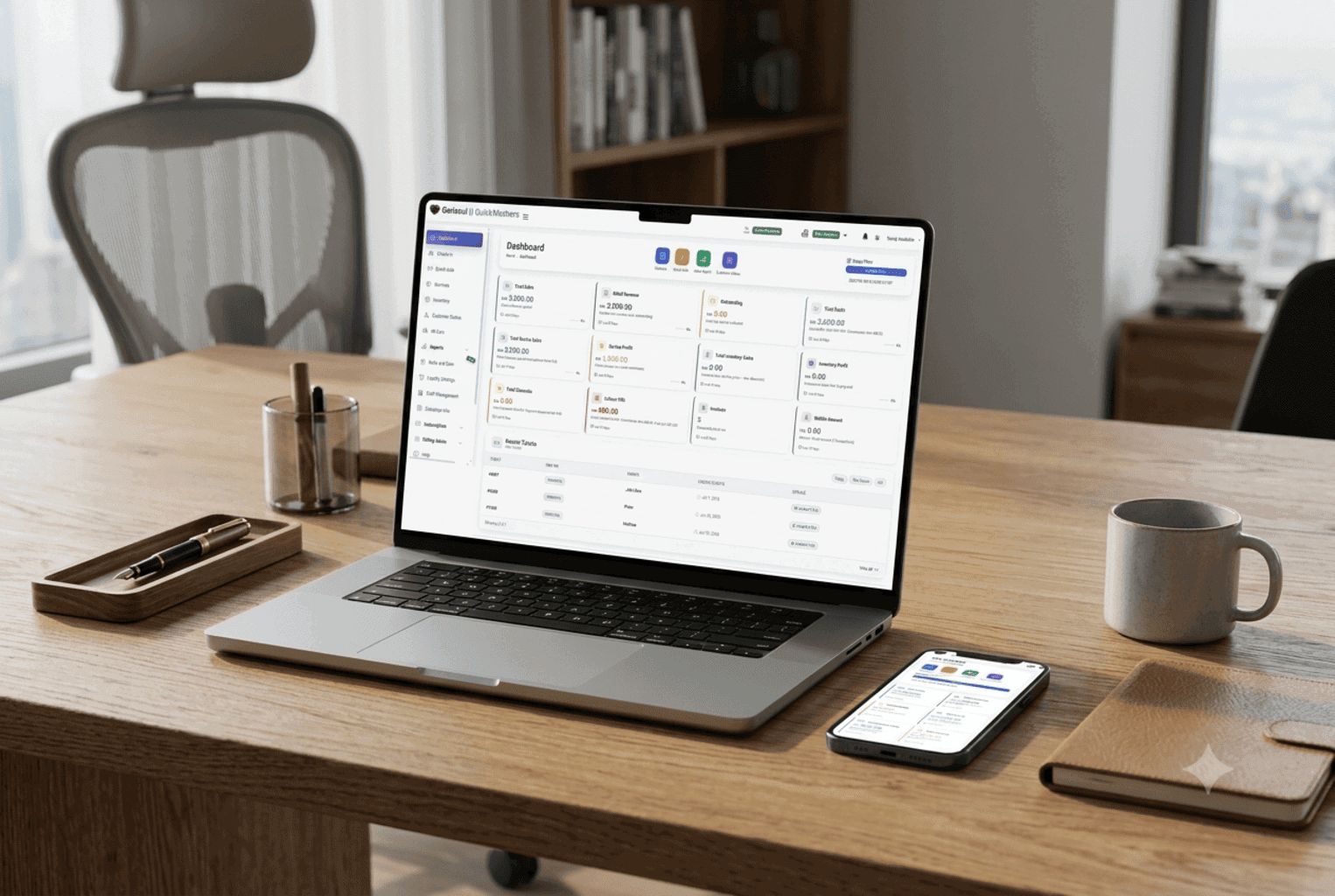
Car wash POS system: choose the right POS to stop losses and increase revenue
If your lanes slow at peak hours or your add-ons disappear unnoticed, a car wash POS system can fix the problem. First, this guide identifies the common operational pains owners face. Next, it gives practical steps you can apply immediately. Finally, it explains how a purpose-built POS—like Garisoul—delivers measurable business gains, not just features.
What is a car wash POS system and why it matters
A car wash POS system handles transactions, records services and add-ons, issues receipts, and links sales to inventory and staff. In addition, it reduces manual errors and speeds checkout. Without one, businesses run on memory or paper, which creates blind spots and hidden losses.
Problem: Slow checkout and lost throughput
Why it happens: manual billing or slow POS screens create queues. Consequently, lanes idle and customers leave.
Impact: lost revenue, poor reviews, and lower weekly throughput.
Immediate fixes:
- Streamline the service menu to 6–8 items for faster selection.
- Train a cashier on two quick keystrokes for common bundles.
- Use contactless payments to shorten transaction time.
Problem: Missed add-ons and low attach rates
Why it happens: staff forget to offer add-ons or the till doesn’t prompt them. As a result, high-margin services remain unsold.
Impact: lower average ticket and poor marketing ROI.
Immediate fixes:
- Create 2–3 visible add-on buttons on the POS home screen.
- Train staff with a 15-second upsell script and measure attach rate daily.
- Run a limited-time add-on discount to test demand.
Problem: Inventory shrinkage and untracked stock
Why it happens: transactions and stock issues live in separate records. Therefore, managers cannot reconcile usage per service.
Impact: higher COGS, surprise stockouts, and inconsistent service delivery.
Immediate fixes:
- Start daily opening and closing stock counts with a simple logbook.
- Measure chemical consumption for one week to set realistic reorder points.
- Label dispensers with standard doses to limit overuse.
What a good car wash POS must do (business outcomes)
Evaluate POS options by outcomes, not buzzwords. Below are essential capabilities and why they matter.
- Fast checkout and offline mode: reduce queue time and avoid lost sales during internet outages.
- Quick-service buttons and bundles: increase attach rate and average ticket without slowing lanes.
- Integrated inventory linkage: tie each sale to stock consumption so you detect shrinkage immediately.
- Digital job cards: record services per vehicle to prevent missed charges and simplify audits.
- Sales, attach-rate and staff reports: make staffing and pricing decisions data-driven.
- Memberships and recurring billing: create predictable monthly cash flow and higher lifetime value.
- Multi-branch support: centralize pricing and procurement to reduce per-site costs.
Buying checklist and demo questions
Bring this checklist to every demo so you buy the POS that solves your top pain point.
- Can it record every service and add-on with one tap?
- Does it link sales to inventory consumption automatically?
- How fast is checkout on a typical day with three lanes? Ask for a live speed test.
- Does it work offline and sync later?
- Can it handle memberships and prepaid packages?
- What reporting is available out of the box—attach rate, cars/hour, labor cost per car?
- What onboarding and local support are included?
- How does it integrate with payment terminals and accounting software?
Costs and ROI examples
Expect software to pay for itself through higher ticket and lower waste. Below are conservative scenarios.
| Scenario | Monthly uplift | Payback |
|---|---|---|
| Single-site: attach rate +10%, waste -25% | KES 25,000–45,000 | 1–3 months |
| Multi-site: ticket +12%, throughput +8% | KES 120,000+ | 1–2 months |
For example, Cloud Starter (KES 9,000 / Quarter) that prompts add-ons and ties sales to inventory will often pay back in weeks through recovered add-on revenue and reduced chemical waste.
Implementation best practices
Effective implementation depends on process design and short training sessions.
- Map current checkout steps and remove any that add no customer value.
- Configure the POS home screen with common bundles and add-ons.
- Run a two-week pilot on a single lane, track attach rate and checkout time.
- Train staff in short sessions and reward top performers on attach rate.
- Review KPI dashboards weekly and iterate quickly.
Why Garisoul’s POS fits car wash operations
Business problem: Many car washes lose revenue through slow checkout, unrecorded add-ons, and stock variance. Manual methods hide these losses.
Why manual methods fail: Paper receipts and unlinked systems make it impossible to trace stock usage to sales. Managers spend time reconciling rather than improving operations.
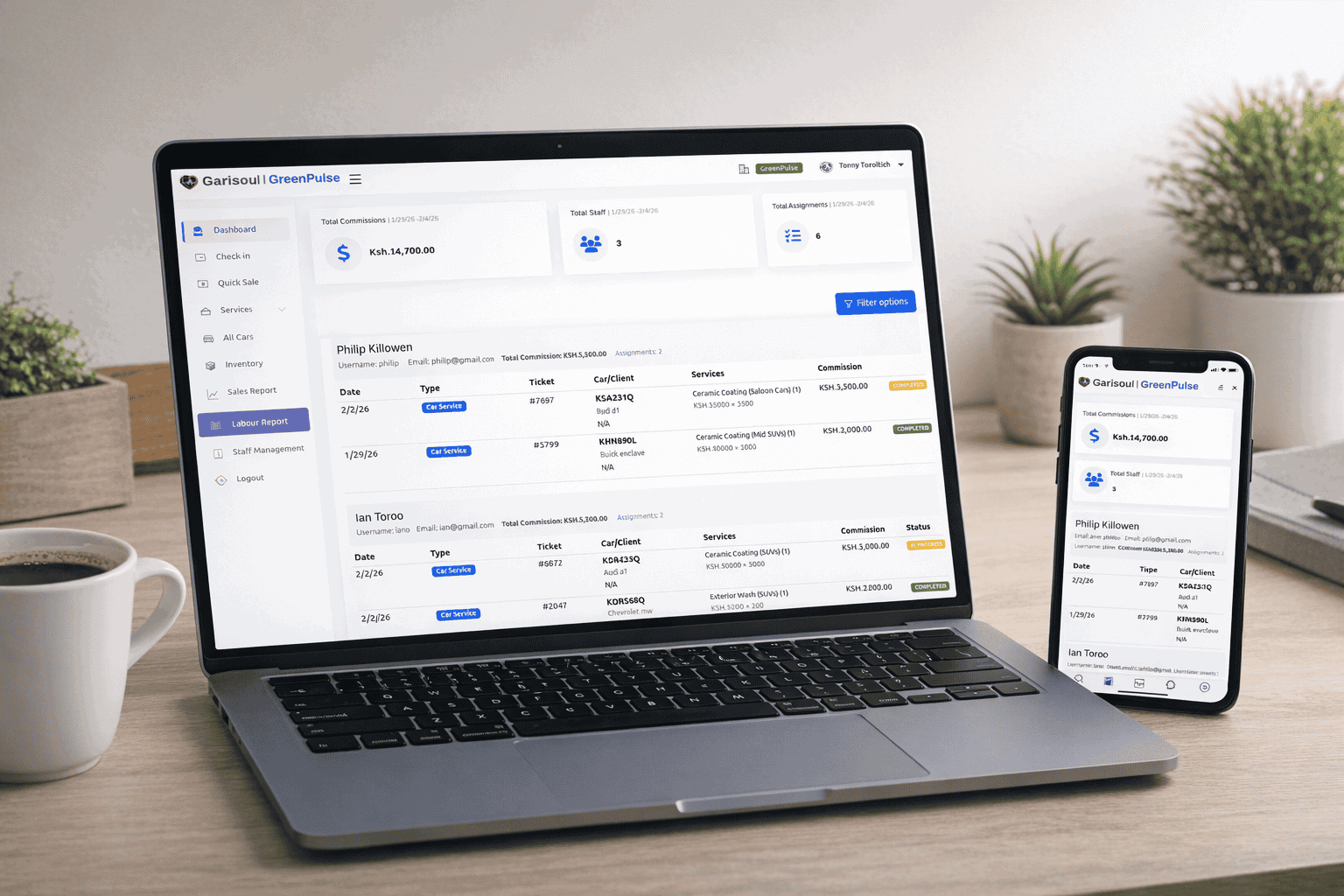
How Garisoul solves it: Garisoul’s Car Wash POS ties every sale to a digital job card and inventory movement. It provides fast checkout buttons, membership billing, and offline operation.
Business benefit: You reduce queue time, capture more add-ons, and detect shrinkage early. As a result, average ticket rises and cost-of-goods-sold falls.
Expected outcome: higher throughput, predictable revenue from memberships, and clear data for pricing and staffing decisions.
Feature outcomes explained
- Digital job cards: stop missed charges by recording services per vehicle; this increases monthly revenue accuracy.
- POS prompts for add-ons: raise attach rates with minimal staff effort, increasing average ticket quickly.
- Inventory linkage: ties each sale to stock use so managers find and fix shrinkage fast.
- Staff analytics: identify idle time and bottlenecks, so you schedule efficiently and reduce labour cost per car.
Customer success story: MetroWash lanes
Problem: MetroWash ran three lanes and used cash and paper slips. Consequently, they lost add-ons and had frequent stock discrepancies.
Implementation: MetroWash deployed Garisoul POS on all lanes, created three standard bundles, and trained cashiers on an upsell script. They linked dispensers to digital job cards.
Results: Attach rate jumped from 10% to 34% in eight weeks. Checkout time dropped 35%, increasing throughput. Inventory variance fell 68% and monthly net profit rose by 26%.
Which Garisoul plan suits your POS needs?
- Cloud Starter — KES 9,000 / Quarter; KES 7,999 onboarding: Ideal for single-location car washes and tyre centres that need a fast, low-cost POS, digital job cards, and basic inventory control.
- Business Licence — KES 59,999 one-time; KES 12,000 annual managed service; KES 9,999 onboarding: Ideal for workshops, garages, fleet operators, and multi-branch businesses needing advanced reporting, multi-site control, and managed onboarding.
FAQ
Does a POS really reduce queue time?
Yes. A well-configured POS with quick-service buttons and contactless payments can cut checkout time by 30–50%, increasing cars per hour.
Will staff accept a new POS?
Yes, when training is short and benefits are clear. Use incentives tied to attach rates to encourage adoption.
Can the POS work offline?
Choose a system with offline sync to avoid lost sales during internet outages. Garisoul supports offline modes and automatic syncing.
How do I measure POS success?
Track attach rate, average ticket, cars per hour, inventory variance, and labour cost per car. Review these weekly.
Resources and links
Explore Garisoul: Garisoul home.
See plans and pricing: Garisoul pricing.
Request a demo or contact sales: Garisoul contact.
Extra operational reading: SpotOn Vacations business tips. Workflow references: NUR Fertility operations.
Conclusion — next steps to improve your lanes
A car wash POS system solves the daily problems that cost you money: long queues, missed add-ons, and untracked inventory. First, identify the single biggest pain in your operation and pilot a POS on one lane. Next, measure attach rate, checkout time, and inventory variance for four weeks. Finally, scale the POS and operational changes across your business. Garisoul’s POS delivers these outcomes with fast checkout, digital job cards, and inventory linkage—helping you increase revenue, reduce waste, and scale with confidence. To see a tailored plan for your operation, visit Garisoul and request a demo; most operators find measurable wins in under 90 days.