
How to Manage a Car Wash Business: A Practical Operations Guide
Running a car wash looks effortless from the outside. Cars arrive dirty, leave clean, and money changes hands. But if you own or manage a car wash, you know the reality is completely different.
Managing a car wash well means coordinating staff across multiple stations, keeping consumables stocked at all times, recording every payment, maintaining equipment, satisfying every customer, and knowing at the end of each day whether you actually made money.
Most car wash owners learn this the hard way. This guide will help you learn it the smarter way — with practical systems, clear strategies, and the right tools for the job.
Why Managing a Car Wash Business Is Harder Than It Looks
On paper, a car wash is a simple business. You charge per vehicle, your team washes it, the customer pays and leaves. In practice, the number of things that can go wrong on any given day is surprisingly long.
Here are the challenges that almost every car wash owner faces at some point:
- Staff not following a consistent washing standard, leading to rework and customer complaints
- Cash that is collected but never recorded, creating unexplained end-of-day shortfalls
- Consumables running out in the middle of a busy shift
- No record of which services were performed on which vehicles
- Customers returning with complaints that cannot be resolved because there is no service history
- No clear way to know which services generate the most profit
- Difficulty managing a second or third location from a distance
Each of these problems is solvable. But they all require systems — and systems require planning. Let us walk through each area of your car wash operation and give you the tools to manage it properly.
Set Up a Clear Daily Operations Routine
The single biggest predictor of whether a car wash runs smoothly is whether it has a documented daily routine. Without one, each day starts differently and mistakes are inevitable.
Start Every Day With an Opening Checklist
Before the first car arrives, your team should complete a standardised opening checklist. This should cover:
- Equipment checks — pressure washers, vacuum cleaners, air compressors
- Consumables review — shampoo, wax, microfiber cloths, tyre dressing
- Station setup — each bay cleaned and ready for service
- POS system open and daily float confirmed
- Staff assigned to their positions for the shift
A checklist takes five minutes to complete and prevents hours of disruption later in the day.
Manage the Service Queue With a Ticketing System
When three cars arrive at the same time, who gets washed first? What services did each customer request? Which member of staff is responsible for each vehicle?
Without a ticketing system, these questions are answered by whoever shouts loudest. That is not management — it is chaos. A simple queue system, whether paper-based or digital, ensures every vehicle is tracked from arrival to departure. A car wash POS system handles this automatically and removes the guesswork entirely.
End Every Shift With a Cash Reconciliation
This is not optional. Every shift should close with a cash count. Follow these steps consistently:
- Count the physical cash in the drawer at the end of the shift
- Print or open the sales report for that shift in your POS system
- Compare the total cash collected to the total services recorded
- Document any variance, no matter how small
- Investigate immediately if the variance exceeds an acceptable threshold
- File the reconciliation report and store it for future reference
A car wash that does daily reconciliations will spot cash problems within days. One that skips them will lose money for months without ever understanding why.
How to Manage Your Car Wash Staff Effectively
Your team delivers your service. If they are inconsistent, your business will be too. Managing staff well is not about being strict — it is about being clear and holding everyone to the same standard.
Define Roles Before Filling Positions
Know what each position does before you hire someone into it. Common roles at a car wash include:
- Exterior wash technician — bodywork, rims, glass, and wheel arches
- Interior detailer — vacuuming, dashboard wipe-down, seat cleaning
- Cashier and reception — receiving customers, recording services, handling payment
- Supervisor — overseeing quality, managing the flow of vehicles, resolving complaints
Overlap between roles is fine, but each person should have a primary responsibility. Accountability requires clarity.
Set Measurable Daily Targets
A team without a target is a team that drifts. Give your staff a daily goal — a revenue target or a minimum number of vehicles to be served. Display it in the wash bay and update it as the day progresses. People who can see a target are more motivated to reach it.
Review performance weekly, not just when something goes wrong. Catch problems early and reward consistency when it appears.
Use Transaction Logs to Surface Performance Issues
A good POS system links every transaction to the staff member who recorded it. If one shift consistently falls short of revenue expectations, you have a clear starting point for investigation. If one cashier's shift regularly shows a cash variance, that is a pattern worth examining closely.
This is not about punishing staff — it is about finding problems before they become habits.
Stock and Supply Management for Car Wash Businesses
Car wash consumables are small items with a big impact on profitability. Running out of shampoo during the afternoon rush means turning away paying customers. Over-ordering ties up cash you cannot afford to have sitting idle. The goal is precise stock management — knowing what you have, what you use, and when to reorder.
The Difference Between Buying and Using
Most car wash owners track what they purchase. Fewer track what they actually consume per vehicle. This distinction matters. If you buy ten litres of shampoo in a week but only wash eighty cars, you should be able to estimate how much was used per wash. If the numbers do not add up, you have a wastage or theft problem worth investigating.
Set Up Stock Management in Five Steps
- List every consumable your car wash uses, from shampoo and wax to microfiber cloths and air freshener
- Record the current quantity of each item in stock
- Estimate average daily usage for each item based on your current vehicle volumes
- Set a reorder point — the quantity at which you automatically place a new order
- Track every delivery from suppliers with purchase orders and receipts filed in your system
Once this process is in place, you will never run out of a key supply unexpectedly, and you will always be able to account for what has been used versus what was purchased.
Work With at Least Two Suppliers
Supplier reliability is never guaranteed. A single-supplier strategy means that when your main supplier is out of stock or delayed, your operation stops. Maintain a backup supplier for your most critical consumables — shampoo, microfiber cloths, and tyre dressing especially. Negotiate credit terms where possible and insist on proper invoices for every purchase.
Revenue Management and Cash Flow Control
Cash flow is where most car wash businesses struggle quietly. Revenue looks reasonable, but profit at the end of the month tells a completely different story. Understanding the gap between those two figures is one of the most important skills a car wash owner can develop.
Make Recording Every Transaction Non-Negotiable
In a busy car wash, it is tempting to let small services go unrecorded — a quick hand wash, a mat shake, a tyre top-up. Each of these unrecorded transactions represents lost revenue. Over a week, lost small transactions can add up to a significant amount of money you can never account for.
Implement and enforce one rule: no service begins until it is recorded. The first month will feel inconvenient. After that, it becomes the default behaviour.
Treat Each Shift as a Separate Financial Unit
If your car wash operates across morning and afternoon shifts, each shift should have its own cash float, its own sales summary, and its own closing reconciliation. Mixing two shifts into a single daily report makes it impossible to trace where a discrepancy occurred.
Review Revenue Reports Every Morning
A daily report should tell you total revenue, number of vehicles served, revenue by service type, revenue by shift, and any cash variances. If your management software generates this automatically, read it before you start your day. Revenue data is only useful if you act on what it shows you.
How to Build Customer Loyalty at Your Car Wash
Acquiring a new customer costs more than keeping an existing one. In the car wash industry, repeat customers are the foundation of stable and predictable revenue. Building loyalty does not require expensive programmes — it requires consistency and a little personalisation.
Record Vehicle History From Day One
When a returning customer's vehicle comes in, your team should know exactly what happened during the last visit. Which services were requested? Were there any issues? Does the customer have a preference — a specific wax, a particular fragrance for the interior?
This kind of detail transforms a transactional car wash into a personalised service experience. Customers who feel remembered return consistently and refer others.
Offer Digital Receipts as Standard
Paper receipts get lost. Digital receipts stay on a customer's phone and serve as a quiet reminder of your business every time they scroll past it. Include your contact information and social media handles on every digital receipt and make sending one a standard part of every checkout.
Create a Simple Loyalty Programme
You do not need a complex mobile app. A recorded visit count in your POS system is enough. Offer a complimentary service after a set number of paid visits — for example, a free interior vacuum after ten full washes. A straightforward loyalty structure increases visit frequency and raises the lifetime value of every customer you serve.
A Story From the Wash Bay
Peter owned a car wash in Eldoret that had been running for two years. By all appearances it was thriving — his bays were busy from eight in the morning to six in the evening, his team of six was working hard, and the cash tin was never empty at the end of the day.
But every quarter, when Peter sat down to calculate his actual profit, the numbers were disappointing. He was spending more on supplies than his revenue could justify. Some days, the cash count was short by several hundred shillings and no one could explain why. When he tried to check how many cars had been washed the previous Monday, no one had a reliable figure.
Peter was busy. But he was not in control.
A colleague suggested he look at car wash management software that included a POS system, stock tracking, and automated daily reporting. Peter was sceptical — he had managed without it for two years. But after another month of unexplained shortfalls, he decided to try it.
Within the first week, he discovered two things. First, several quick interior cleans were being performed without being recorded in the system. The team was not necessarily stealing — they had simply developed a habit of doing fast services informally. But those unrecorded services amounted to roughly KES 3,000 in lost revenue every week.
Second, his shampoo consumption was significantly higher than his vehicle count could explain. After investigating, he found that two team members were using twice the recommended amount per vehicle. A fifteen-minute training session fixed the problem.
Six months later, Peter had opened a second car wash location. He manages both from a single dashboard and reviews the morning report for each branch before his day begins.
Why Car Wash Businesses Need Management Software
Running a car wash on manual records is possible when volume is low. As soon as you are serving more than thirty vehicles a day, the gaps in manual management become expensive. The difference between what you are actually earning and what you can actually prove you earned grows wider with every additional car.
A dedicated car wash management system closes those gaps by:
- Recording every service automatically at the point of sale
- Tracking stock levels in real time and alerting you when items need reordering
- Linking every transaction to a specific staff member or shift
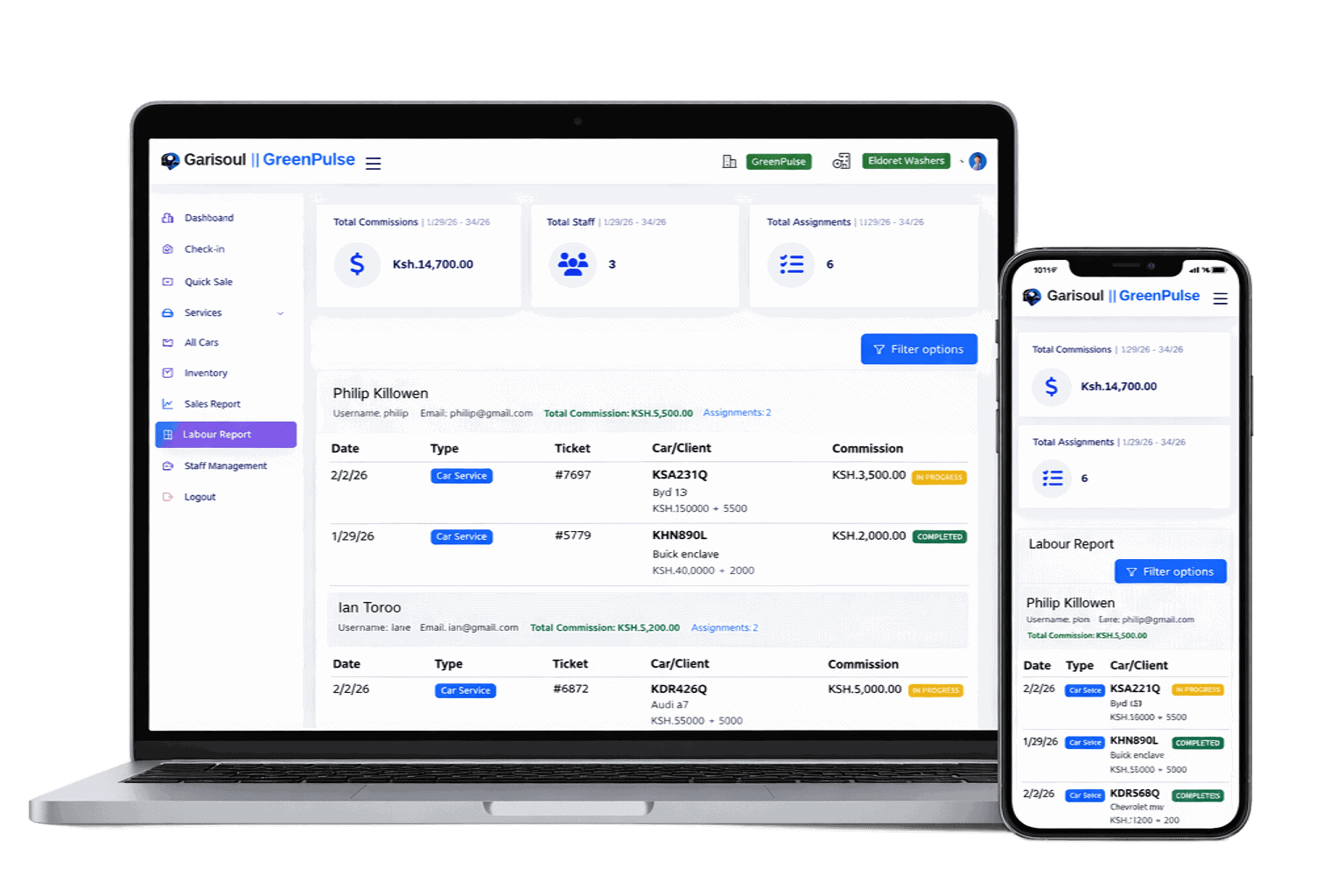
- Generating daily, weekly, and monthly revenue reports automatically
- Storing complete vehicle service histories accessible in seconds
- Supporting multiple branches from a single platform
These are not luxuries. For a growing car wash business, they are operational requirements.
How Garisoul Helps You Manage Your Car Wash Business
Garisoul is a car wash and garage management platform built specifically for automotive businesses in Africa. It was designed around the real challenges that local car wash owners face every day — not adapted from a generic retail system.
Car Wash POS That Eliminates Revenue Leakage
The problem: Services are being delivered but not recorded, creating cash gaps you cannot explain.
The solution: Garisoul's car wash POS records every service the moment it is initiated — capturing the vehicle, the service type, the staff member on duty, and the payment amount in real time.
The benefit: You close every shift with a complete and accurate record of every transaction. Reconciliation takes minutes, and cash variances become impossible to hide.
Inventory Tracking That Shows Exactly What You Are Using
The problem: Supplies run out without warning, or consumption is consistently higher than your revenue can justify.
The solution: Garisoul's inventory module tracks every consumable item, allows you to set automatic reorder alerts, and compares usage against the number of vehicles served.
The benefit: You never run out of stock unexpectedly, and any unusual consumption pattern becomes visible immediately — helping you identify wastage or theft before it becomes a significant loss.
Staff Tracking That Builds Natural Accountability
The problem: You cannot tell which staff member handled which vehicle, or which shift produced what revenue.
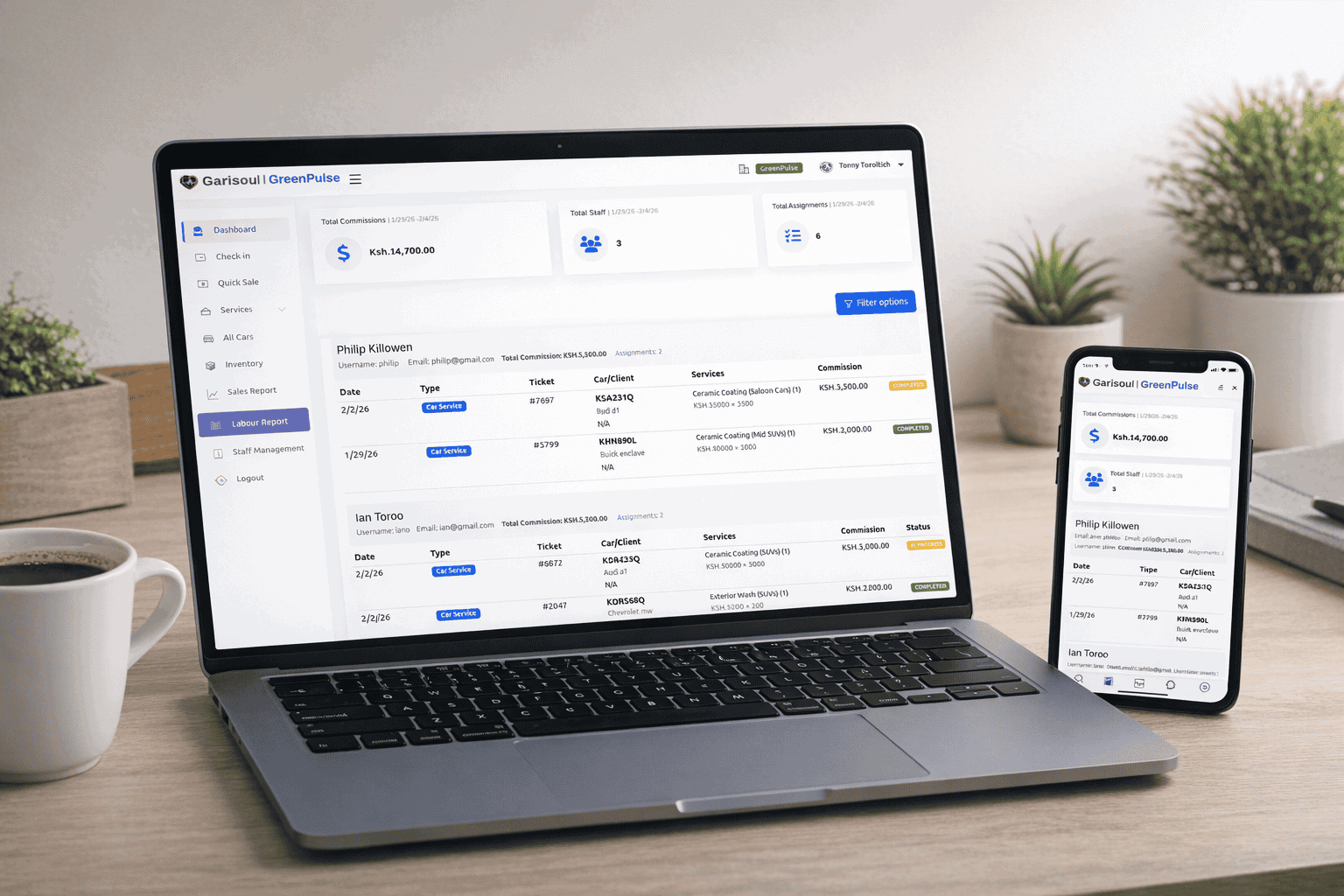
The solution: Every transaction in Garisoul is linked to the staff member who processed it. Shift-level and individual reporting shows you exactly how each team member and each shift performed.
The benefit: Accountability improves naturally. When staff know that their performance is visible, standards rise consistently — without you having to micromanage every individual situation.
Business Reports That Drive Smarter Decisions
The problem: You make pricing and staffing decisions based on gut feel because you have no detailed performance data.
The solution: Garisoul generates revenue reports, service breakdowns, and business analytics that show you which services are most profitable, which days are busiest, and where your money comes from.
The benefit: Every decision — pricing changes, service menu adjustments, staffing levels — is grounded in real numbers from your own operation, not guesswork.
Vehicle History and Digital Job Cards
The problem: Returning customers are treated like new customers every visit because there is no service history on file.
The solution: Garisoul stores a complete service record for every vehicle. When a registration number is entered, all previous services, dates, amounts, and notes are displayed instantly.
The benefit: Your team can provide a personalised experience from the first return visit, building the kind of trust and loyalty that brings customers back month after month.
Multi-Branch Management From One Dashboard
The problem: You want to open a second location, but managing it remotely feels impossible.
The solution: Garisoul's multi-branch feature lets you monitor revenue, stock levels, and staff performance across all your locations from a single platform.
The benefit: Growth becomes manageable. You can open a second or third car wash confident that you will have the same level of visibility and control as you have over your first.
Garisoul Pricing Plans
Garisoul offers two plans to suit different business sizes and stages. Full details are available on the Garisoul pricing page.
Cloud Starter — For Small and Growing Car Washes
- Subscription: KES 9,000 per quarter
- Onboarding: KES 7,999 (one-time)
This plan is ideal for small car washes and startups that want to move from manual management to a proper digital system without a large upfront investment. It includes car wash POS, stock tracking, daily sales reports, and digital receipts — the core tools for getting your business properly under control.
Business Licence — For Larger Operations and Multi-Branch Businesses
- Licence fee: KES 59,999 (one-time)
- Annual managed service: KES 12,000 per year
- Onboarding: KES 9,999 (one-time)
This plan is built for established car washes, fleet operators, and multi-branch businesses that need a comprehensive management platform. It includes full business analytics, multi-branch management, purchase order tracking, supplier management, and priority technical support.
Frequently Asked Questions About Managing a Car Wash Business
What does effective car wash management actually involve?
Effective car wash management covers daily operations, staff supervision, stock control, cash handling, customer experience, and financial reporting. It requires consistent processes, clear accountability at every level, and regular review of your business performance data to identify what is working and what needs to change.
How do I reduce or stop cash theft at my car wash?
The most effective approach is to implement a POS system that records every service before cash changes hands. When every transaction is logged in real time and linked to a specific staff member, theft becomes extremely difficult to conceal. Daily cash reconciliation between physical cash and the system record is equally important and should never be skipped.
Do I really need software to manage a car wash business?
For a very small operation washing fewer than twenty vehicles a day, manual records can work in the short term. But as volume grows, manual systems create gaps that cost you real money. Car wash management software gives you speed, accuracy, visibility, and automated reporting that manual methods simply cannot match — and the cost of the software is quickly recovered through reduced losses alone.
How many staff do I need to run a car wash?
A standard car wash typically needs one to two wash technicians per active bay, plus a cashier and a supervisor for quality control. Staff requirements increase as daily vehicle volume grows. Garisoul's shift and staff reporting helps you identify the right staffing level for different times of day and days of the week based on your actual historical data.
How do I track car wash revenue accurately?
Use a POS system to record every transaction the moment it is initiated. Reconcile cash at the end of each shift before staff leave. Review daily, weekly, and monthly reports to monitor trends and catch anomalies early. Never rely on estimates or end-of-month guesswork — accurate revenue management depends entirely on real-time data capture.
What is the best way to manage car wash supplies?
Track purchases and usage separately, not just together. Set reorder points for every key consumable so you maintain a safe buffer at all times. Compare stock consumption against vehicle count regularly — if usage is higher than your service volumes justify, investigate immediately. A stock management system with automatic reorder alerts removes the guesswork entirely.
Take Control of Your Car Wash Business Today
Managing a car wash business well is not about being everywhere at once. It is about building systems that work consistently — systems that record every transaction, track every item, monitor every shift, and tell you exactly where your business stands at any given moment.
The car wash businesses that grow are not always the ones with the best location or the newest equipment. They are the ones that know their numbers, manage their teams with clear expectations, and use the right tools to stay in control as they scale.
If you are ready to build that kind of operation, get in touch with the Garisoul team and find out how the right car wash management software can transform the way your business runs.